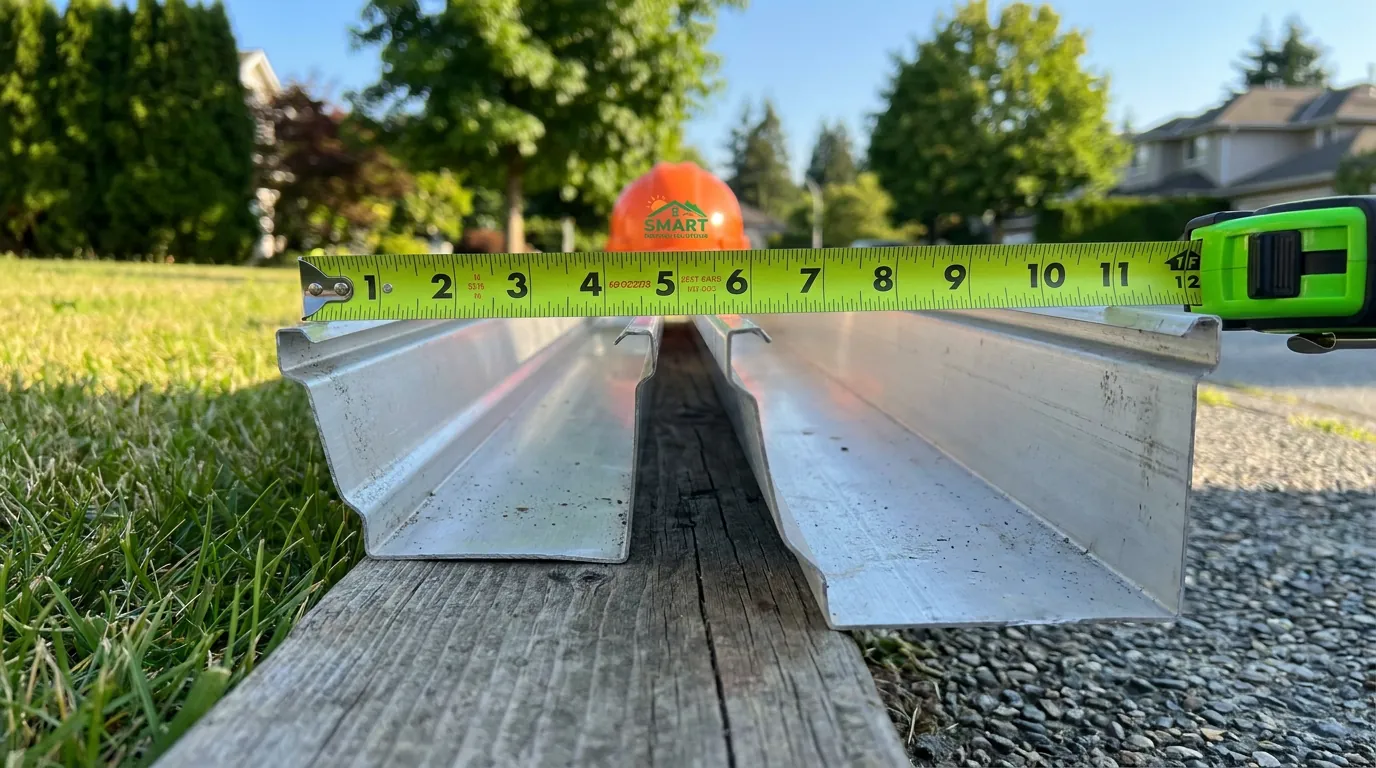
When homeowners choose new gutters, the conversation usually centres on colour and material. But there is a more important decision hiding underneath: the size. Gutters come in different widths, most commonly 5-inch and 6-inch, and that width decides how much water the system can move at once. In Metro Vancouver, where the rain comes hard and often, getting the size right is the difference between gutters that keep up and gutters that overflow.
Does Gutter Size Really Matter?
Yes, more than most people expect. A gutter is a channel, and a wider channel carries more water. When rain falls faster than the gutters can drain, the excess spills over the edge, exactly the overflow that damages fascia, siding, and foundations. In a heavy-rain climate, capacity is not a luxury; it is what keeps the system working during the storms that matter most.
5-Inch vs 6-Inch Gutters
Here is how the two standard residential sizes compare:
| Feature | 5-inch | 6-inch |
|---|---|---|
| Water capacity | Standard | Roughly 40% more |
| Downspout pairing | Usually 2x3 inch | Usually 3x4 inch |
| Clog resistance | Good | Better, wider channel |
| Cost | Lower | Slightly higher |
| Best for | Average roofs, moderate rain | Large or steep roofs, heavy rain |
How Much More Water Does a 6-Inch Gutter Handle?
The jump from 5 to 6 inches sounds small, but it is significant. A 6-inch gutter holds noticeably more water, on the order of 40 percent more capacity, and is usually paired with larger downspouts that drain it faster. That combination means a 6-inch system can handle a sudden downpour or a large roof's runoff without backing up, where a 5-inch system might overflow.
Downspout Size Matters Too
Gutter width is only half the story. The downspouts have to carry away everything the gutters collect, so a wide gutter on undersized downspouts still backs up. Larger 3x4-inch downspouts move far more water than the standard 2x3-inch size and clog less easily, since more debris can pass through. Adding a second downspout to a long run is another way to increase how fast a gutter drains. Properly matched gutters and downspouts, and enough of them, are what make the system work as a whole.
When Should You Choose 6-Inch Gutters?
Bigger gutters are worth it in several common situations:
- Large roof areas that shed a lot of water into the gutters
- Steep roofs that send water into the gutters faster
- Homes under heavy tree cover, where the wider channel resists clogging
- Properties with a history of overflow even after cleaning
- Long gutter runs that collect water over a greater distance
When Are 5-Inch Gutters Enough?
For many homes, the standard size does the job:
- Average-sized roofs with moderate slopes
- Homes without heavy overhanging trees
- Shorter runs that drain quickly to a downspout
- Budget-conscious projects where the roof does not demand extra capacity
Can You Upgrade From 5-Inch to 6-Inch Gutters?
Yes. If your current 5-inch gutters overflow despite being clean, switching to 6-inch is a common and effective upgrade. It means new gutters and usually larger downspouts, since the bigger channel needs bigger outlets to drain it. Because it replaces the gutter run, it is most cost-effective to do when the gutters are due for replacement anyway, though persistent overflow alone can justify the upgrade on a home that clearly outgrew its original size.
Does a Bigger Gutter Mean Less Cleaning?
To a degree, yes. A wider 6-inch channel paired with larger downspouts is more forgiving of debris: leaves and needles are less likely to bridge the gap and form a clog, and there is more room before a partial blockage causes overflow. It does not eliminate cleaning, since debris still collects, but it buys more margin between cleanings, which is a real advantage on tree-heavy lots.
What About Even Larger or Custom Sizes?
Beyond 6-inch, larger and custom gutter sizes exist, but they are generally reserved for commercial buildings or unusually large roofs. For nearly all Metro Vancouver homes, the real choice is between 5-inch and 6-inch, with 6-inch at the larger end of what residential roofs typically need. If your roof is large or complex enough that even 6-inch seems marginal, that is a good reason to have the runoff properly calculated rather than guessing.
Why Sizing Matters So Much in Metro Vancouver
Our region's rainfall is the reason this decision carries more weight here than in drier places. Long, intense wet spells push gutters to their limits, and a system that is marginally sized will overflow exactly when it is raining hardest. Many overflow problems that homeowners blame on clogs are really a capacity problem; the gutters simply cannot move water fast enough. Sizing the system for our climate, rather than the bare minimum, prevents that.
How Do You Get the Sizing Right?
The right size depends on your roof area, its slope, your local rainfall, and how much debris your gutters collect. A professional can calculate the runoff your roof produces and recommend the gutter and downspout sizes to match it during a gutter installation. If your current gutters overflow despite being clean, undersizing may be the cause, and a gutter repair or upgrade can add capacity where it is needed.
Size for the Rain You Actually Get
Gutters that are sized for Metro Vancouver's rain, with downspouts to match, simply keep up when it counts. Undersizing is one of the most common reasons a perfectly clean gutter still overflows, and it is entirely avoidable at the planning stage. If your gutters overflow in heavy rain or you are planning new ones, it is worth getting the sizing right rather than defaulting to the smallest option to save a little up front. To find the right size for your home, call us at 778-238-3280 or request a free quote.
Frequently Asked Questions
What is the difference between 5-inch and 6-inch gutters?
Do I need 6-inch gutters in Metro Vancouver?
Does downspout size matter as much as gutter size?
Why do my gutters overflow even though they are clean?
Are 5-inch gutters ever enough?
Need Professional Help?
Contact Smart Gutter Solutions for a free consultation and estimate.